Sudoku looks like a maths puzzle, but it isn't. There is no adding, no multiplying and no right answer you need to know in advance. You only need patience and a pencil, which is why so many older adults take it up and keep it up for years.
If the classic 9x9 grid in the newspaper has always looked like a wall of boxes, this guide is for you. It explains the rules in plain words, gives you a small starter puzzle with the answer, and shows how to step up gently.
The Rules in One Sentence
Fill the grid so that every row, every column and every box contains each number exactly once.
That's all. On a 4x4 grid the numbers are 1 to 4. On a 6x6 grid they are 1 to 6. On the classic 9x9 grid they are 1 to 9. Some numbers are already filled in when you start, and a good puzzle has only one solution.
Start Small: A 4x4 Puzzle to Try
The quickest way to learn is a tiny grid. This one is split into four boxes of 2x2 (top left, top right, bottom left, bottom right). Each row, column and box needs the numbers 1, 2, 3 and 4 once each. A dash means an empty square.
| Col 1 | Col 2 | Col 3 | Col 4 | |
|---|---|---|---|---|
| Row 1 | 1 | – | – | 4 |
| Row 2 | – | 4 | 1 | – |
| Row 3 | – | 1 | 4 | – |
| Row 4 | 4 | – | – | 1 |
Copy it onto paper in big writing, or simply say your answers out loud. A good first step: Row 1 already has 1 and 4, so the two empty squares need 2 and 3. Column 2 already has 4 and 1. Which one goes where?
Answer (no peeking until you've tried):
| Col 1 | Col 2 | Col 3 | Col 4 | |
|---|---|---|---|---|
| Row 1 | 1 | 2 | 3 | 4 |
| Row 2 | 3 | 4 | 1 | 2 |
| Row 3 | 2 | 1 | 4 | 3 |
| Row 4 | 4 | 3 | 2 | 1 |
If that felt easy, you're ready for 6x6. If it felt hard, try it again tomorrow. Most people find the second puzzle much easier than the first, because the method starts to feel natural.
Four Beginner Tricks That Solve Most Easy Puzzles
1. Look for the "nearly full" line
Scan for a row, column or box with only one empty square. There's only one number it can be. Fill it in, and that often opens up the next one.
2. Ask "where can this number go?"
Pick a number, say 3, and look at one box. Cross out every row and column in that box that already has a 3 somewhere else. Often only one square is left. This is called "cross-hatching" and it is the single most useful sudoku skill.
3. Use pencil notes
In a harder square, write the possible numbers small in the corner. When you rule one out, cross it off. On paper, a pencil and a soft eraser help a lot. In an app, look for a "notes" or "pencil" mode.
4. Never guess
Easy and medium puzzles can always be solved by logic alone. If you feel you need to guess, take a break and look again. A fresh look usually finds the step you missed.
Stepping Up: From 4x4 to 9x9
| Grid | Numbers | Good for |
|---|---|---|
| 4x4 | 1 to 4 | Learning the rules in five minutes |
| 6x6 | 1 to 6 | Building confidence, 10 to 15 minutes |
| 9x9 "easy" or "gentle" | 1 to 9 | The classic newspaper puzzle |
| 9x9 "medium" | 1 to 9 | When easy puzzles feel quick |
There is no rush to move up. Plenty of people play easy 9x9 puzzles for years and enjoy every one.
Making Sudoku Easier on the Eyes
Small printed grids are the most common reason people give up on sudoku. A few fixes:
- Large print puzzle books. Ask at the library or a newsagent; many puzzle publishers sell large print sudoku. See our guide to puzzles for seniors for more on choosing large print.
- Enlarge on a photocopier. A newspaper puzzle copied at 150% is far easier to fill in.
- A good lamp and a soft pencil make the numbers stand out.
- A tablet. On a screen you can make the grid as big as the device allows, and mistakes disappear with one tap. Games for seniors with low vision has more ideas.
Where to Play Sudoku for Free
- Newspapers and the library. Most papers print a daily sudoku, and the library often has puzzle books to borrow.
- In the browser. Many newspaper sites and AARP Games offer sudoku online. Some show ads.
- Make your own small puzzles. Fill a 4x4 grid correctly, rub out half the numbers, and give it to a friend or grandchild to solve.
Mini Sudoku in SilverMind
SilverMind is our own app of calm brain exercises for older adults, so we'll be upfront. Its Mini Sudoku uses small grids with large numbers: tap a square, then tap a number. There is no clock and no ads, and Mini Sudoku is one of the 8 exercises that stay free with no subscription.
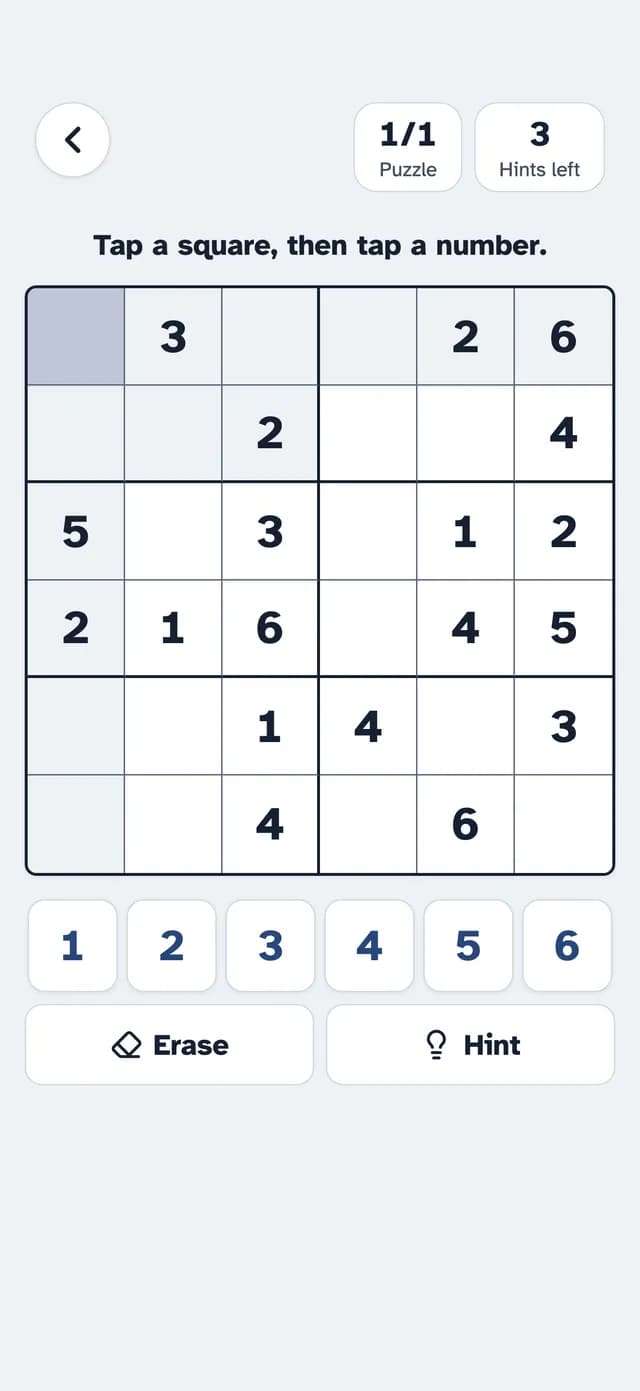
You can try it without installing anything at silvermind.app/play, which works on Android phones and computers too, or on iPhone and iPad from the App Store. If you'd like more after that, Premium unlocks all 28 exercises.
Does Sudoku Help the Brain?
Honest answer: we don't know for sure. A large online study of more than 19,000 adults aged 50 to 93 found that people who did number puzzles more often scored better on thinking tests. But that kind of study can't tell whether puzzles sharpen the mind, or whether people with sharp minds simply enjoy puzzles more. The National Institute on Aging notes that people improve at the tasks they practice, while evidence for broader benefits is limited, and no game has been shown to prevent dementia.
What sudoku reliably offers is a calm, absorbing quarter of an hour and the small pleasure of finishing something. That's reason enough. Pair it with a walk, good sleep and time with people, and see a doctor about any memory changes that worry you.
More Puzzles to Enjoy
- Like words more than numbers? Try large print crossword puzzles.
- Want gentle number games without grids? See math games for seniors.
- Looking for something to print? Our free printable worksheets include number sequences and everyday maths, all with answers.
Research & References
- The relationship between the frequency of number-puzzle use and baseline cognitive function in a large online sample of adults aged 50 and over - Brooker et al., International Journal of Geriatric Psychiatry, 2019
- Cognitive Health and Older Adults - National Institute on Aging
- AARP Games - AARP